
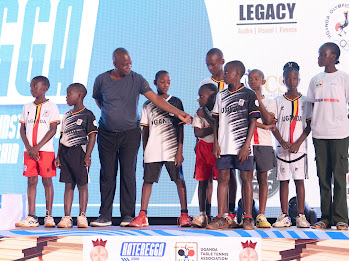
By Mr. Emmanuel Matsyetsye- CEO Mbale Tigers Table Tennis Club.
The sharp tik-tok, tik-tok of a small yellow ball bouncing across a table may seem ordinary to many. But for one young boy growing up in Mbale, that sound would ignite a passion that would eventually transform Ugandan table tennis and inspire generations of players.
For decades, table tennis in Uganda was largely concentrated in the Central Region. The sport thrived in Kampala’s social clubs and prestigious schools such as Buddo Secondary School, Busoga College Mwiri, Namilyango College, St. Mary’s College Kisubi, and Nabumali High School. For many children from rural Uganda, access to the sport was almost non-existent.
Yet destiny often begins with a simple moment.
While attending Nabumali High School, a young table tennis enthusiast found himself in a unique environment. His father worked with the Mbale Diocese and lived within the cathedral grounds. Adjacent to the residence stood a church hall where children from prominent table tennis families regularly gathered to play.
The rhythmic sound of the ball captured his imagination.
“Tik. Tok. Tik Tok.”
It was more than just a game—it became a calling.
Years later, that childhood fascination would evolve into the creation of Mbale Tigers Table Tennis Club, a club that would grow from humble beginnings into one of Uganda’s most respected table tennis institutions. The founder’s passion for the sport was so deep that he even composed an anthem for the club, a symbol of the identity and pride that Mbale Tigers would come to represent.
What started as a local initiative soon expanded beyond district boundaries. Through dedication, strategic planning, and community engagement, Mbale Tigers developed into a model sports-for-development organization. The club was registered as a nonprofit organization and received support from the Swedish International Development Cooperation Agency for a decade, helping to strengthen its programs and outreach.
The success of Mbale Tigers opened doors at the national level. Its founder rose through the ranks of the Uganda Table Tennis Association, serving first as a committee member, then General Secretary, Vice President, and ultimately President from 2007 to 2009.
Leadership in Uganda’s table tennis fraternity brought international opportunities. Through the association, he represented Uganda at World Championships and International Table Tennis Federation congresses across Europe and Asia. One of the highlights came during the 2009 World Table Tennis Championships in Yokohama, Japan, where he presented research at the 11th Sports Science Congress. The work was later published in the International Journal of Table Tennis Sciences in 2010, placing Ugandan table tennis scholarship on the global stage.
Yet the mission was never solely about trophies and titles.
Mbale Tigers embraced a broader vision: using sport as a tool for social transformation. The club pioneered programs that linked table tennis with education, youth empowerment, health awareness, and community development. This innovative approach earned recognition from organizations including UN-Habitat, UNICEF, World Vision, and Stanbic Bank Uganda.
The model proved so effective that schools, social clubs, and corporate organizations across Uganda began adopting similar approaches. Initially aligned with the United Nations Millennium Development Goals (MDGs), the club’s activities have since evolved to support the Sustainable Development Goals (SDGs) agenda for 2030.
The impact of this work extended beyond sport. It contributed to the award of a Master of Science scholarship at the University of Peloponnese, demonstrating how sports leadership can create opportunities far beyond the playing arena.
Today, more than three decades after that first encounter with a bouncing table tennis ball, Mbale Tigers stands as a symbol of resilience, vision, and community impact. From 1992 to 2026, the club has endured because of the commitment of players, coaches, sponsors, partners, and supporters who believed in its mission.
The story of Mbale Tigers is proof that greatness can emerge from the most unexpected places. A simple church hall. A yellow ball. A rhythmic tik-tok echoing through the air.
What began as a childhood fascination has become one of Uganda’s most remarkable sporting success stories—a movement that continues to inspire the next generation of champions.